

More participants (includes law, art, philosophy, education, military, journalism, economics, consulting and religion)
More participants (includes law, art, philosophy, education, military, journalism, economics, consulting and religion)

David Wolk and Martha Farah at beginning of presentation

38 participants in day long lectures with field visits to labs and small group discussion sessions
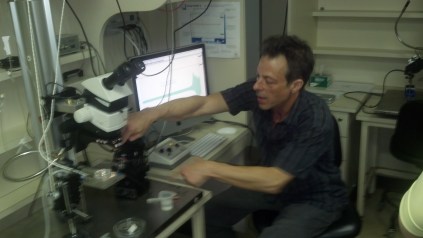
Mike Kaplan at setting electrode to chart action potential in neurons
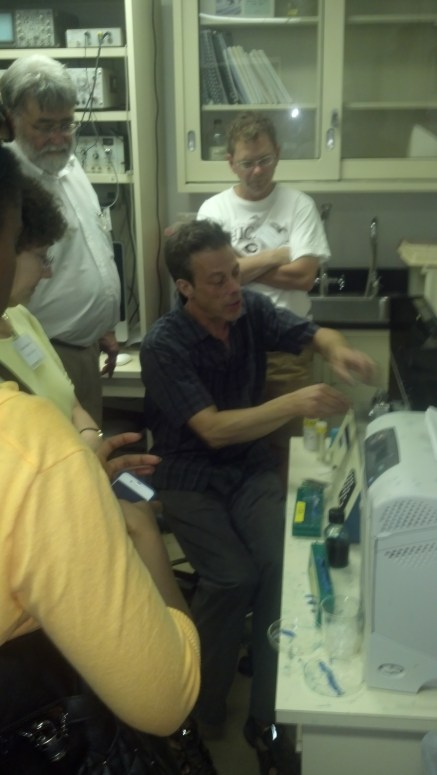
Mike Kaplan demonstrates creation of glass electrode, crucial in testing action potential in a neuron
This morning has been basically an overview of the cellular neuroscience and neuroschemistry particularly in how neurons exchange energy/information using electro chemical interactions. I am not going to attempt a full overview but it is amazing how nuanced the exchanges occur at the molecular level (for instance what a potassium i ion channel looks like)  http://www.osti.gov/accomplishments/mackinnon.html
In addition we discussed pharmachology and how different neurotransmitters create different neurological responses

A neurotransmitter defines A chemical that is released from a nerve cell which thereby transmits an impulse from a nerve cell to another nerve, muscle, organ, or other tissue. A neurotransmitter is a messenger of neurologic information from one cell to another.
This afternoon we will discuss the implications of different drugs upon the brain both therapeutically and pathologically.
Currently at a 10 day intensive on Neuroscience and Society at the University of Pennsylvania called the Neuroscience Bootcamp
http://www.neuroethics.upenn.edu/index.php/education/neuroscience-boot-camp
After a basic introduction to Neuroscience the last two days were focused on research methodology, particularly around the fMRI (physics of how fMRI works as well as reserach approaches). The group consists of legal professionals and professors of law, philosophers, art historians, economists, behavioral science specialists, science writers, educators, and policy makers… and a colleague Fred Eddie who teaches CE, liturgy, and Youth at Duke Divinity School. Will be posting both on twitter and DC Facebook group as I go.
Interesting conversation at the end of yesterday as to why the pictures from fMRI studies seem so compelling. Dr. Geoffrey K. Aguirre (MD, PhD and leading fMRI researcher) noted the power of the machines, the ability to “smooth out” (rightfully) images so they look like they are an organic part of the brain, and societies proclivites to believe more once they see it, probably lends to this phenomenon. Eddie noted that fMRI imagery can prove iconic in a societal “liturgy” of science and health. Eddie was borrowing from James K Smith’s work but this was a powerful insight I think to the formative power within this body of research.
A lot of great information also about the science. I now have a much better understanding of the workings of fMRI machines (their different strengths and abilities) as well as stronger understanding of the statistical variables that go into these studies (and a bit more info to discern good from bad studies). The implications for education, formation, and therapy will be following but this gathering is eye opening. More later.

Professor of Practical Theology and Christian Discipleship, Nazarene Theological Seminary

 Discipleship Commons