Wired Faculty

Bill SelvigeSo, how many social media sites do you have to maintain to be considered a truly “wired” faculty member?

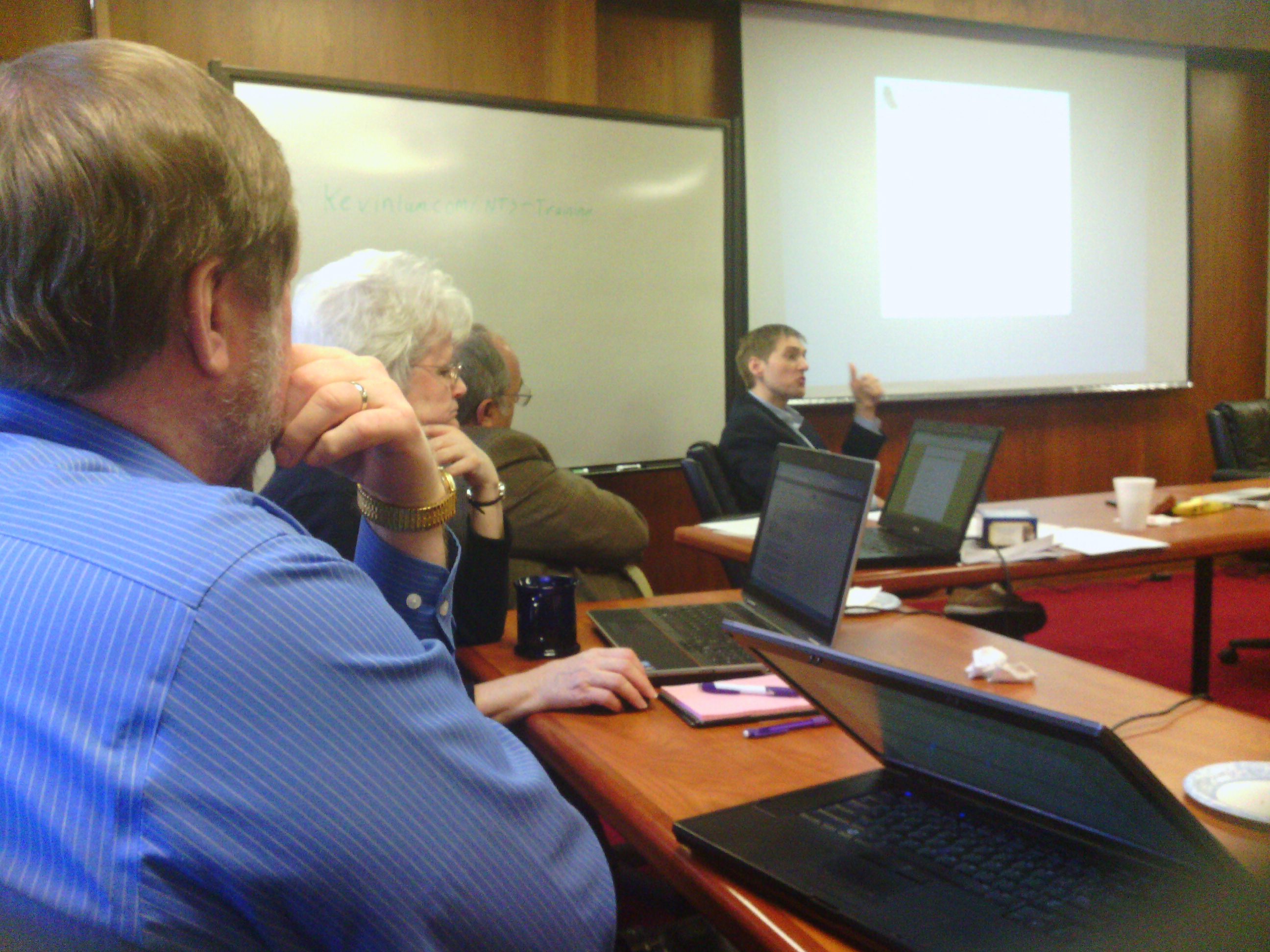
IMG_20130117_104756 I began to wonder about setting a mythical standard as Kevin Lum  unpacked several more approaches to social media. After Kevin finished his presentation on blogging, he continued the workshop for NTS faculty by providing introductions to hosting webinars, navigating facebook, curating twitter feeds, and learning to find the right format that matches personal inclination and student interest.

Continue reading

Posted in Culture, Higher Education, Pedagogy, Social Media, Technology | 1 Comment

Social Media as Theological Education


Bible-App-Smartphone
Must Theological Education embrace social media? What difference will it make in not just promoting the seminary but communicating, even educating, constituents? Looks like technology, theology, and education have found a new intersection for everyone.

Kevin Lum, Executive Vice President of SAI, and an NTS Grad, spent the morning working w ith NTS faculty on the power of social media, particularly focusing on ideas worth spreading. The power of social media is impressive and even theological education has to embrace

this view. We saw several great video overviews that I will try to post via my twitter feed @disciplecommons. Kevin included a number of other key insights:

Continue reading

Posted in Culture, Discipleship, Higher Education, Pedagogy, Social Media, Technology | 10 Comments

Twittiquette? or an Educational Strategy for Tweets?

It was bound to happen, the increase in Twitter feeds has sparked a number of blog sites on twitter etiquette… er, is that Twittiquette? Brittany Fitzgerald’s recent article on the Huffington Post is just the most recent example, titled “What Not To Tweet: 15 Annoying Things We Never Want To See On Twitter Again.” She notes:

According to a recent study from the Pew Research Center, daily adult usage has doubled from May 2011 to May 2012, with 31 percent of 18 to 24-year-olds signed up.The expansion of accounts throughout the last year has many novice users coming to terms with what is considered socially acceptable Twitter behavior. Even experienced tweeters are now confronted with a much more complex system than in 2006, with automated posts, promotional tweets, and constantly morphing features.

So will Twitter just another self indulgent slight of hand? For some perhaps, but I think there are other uses… at least I hope so since I manage several Twitter feeds :0-) First, Twitter may be the fastest way to crowd source a number of exceptional articles online and curate them into regular feeds on a website. I have used Twitter feed widgets on this blog just to manage varying resources on family spirituality, media, neuroeducation and higher education. Now that many quality news sources post leads on stories through twitter you can catch “headlines” even more quickly than before. Of course there is the occasional, “I just got out of bed this morning tweet,” but that only rivals the message board of Facebook on any given day. What you have is a cross between the old telephone “party line” of listening into people’s lives with the more helpful electronic version of the Associated Press or United Press International Wire Services, but with much more focused  topics.

Continue reading

Posted in Culture, Discipleship, Pedagogy, Social Media, Technology, Uncategorized | Leave a comment

Editing as Discipleship

Theological Education

Just received word that I am now a member of two editorial boards. The first appointment came as a surprise this past summer when invited to serve on the journal Theological Education, a journal sponsored by the Association of Theological Schools, the accrediting agency for most seminaries and divinity schools. I have to be honest and say that the invitation did not set in till I opened a copy of Theological Education today and found my name listed as part of the 2012-2014 Editorial Board.

The second honor came as I was wrapping up my year as president of the Religious Education Association. Jack Seymour, editor for the journal, invited me to serve on the editorial board of that association, titled Religious Education. This journal is one of the most prestigious in its field and it is an honor just to have a publication much less serve as one of the editorial board.

Continue reading

Posted in Discipleship, Higher Education, Journals, Pedagogy | Leave a comment

Scottie May Presentations in Children’s Ministry

ImageJust received word that Scottie May’s two presentations this spring includes a morning lecture titled “Why Welcoming Children Welcomes Jesus,”and the afternoon seminar is titled “How Welcoming Children Welcomes Jesus.” May is the guest lecturer for the NTS Miriam Hall Lecture in Children’s Ministry, occurring April 9th. Morning presentation begins at 10:30 am followed by a brown bag luncheon and afternoon seminar. Local and national children’s ministry leaders will be present.

Posted in Uncategorized | Leave a comment

EPIC 2020

One major video prognostication of the future of education in the United State circulating these days is called EPIC 2020. The video concept includes a projection that includes downloading free lectures and then crowd sourcing student interaction/questions to insure solid online interaction. Ultimately students would merely take exams (for a fee) to pass the course and receive “badges” or certifications when completed. The concept, you will see, surfaces in part due to the new popularity of the Kahn Academy and the idea of the “flipped classroom” where exemplary teachers provide prepared lectures prior to classes and students and teachers spend time in the class itself exploring and building on the “content” in the lectures. As you watch the video (pretty compelling) you get the sense that the itunes/youtube generation is ready for mix and match video lectures with Amazon like ratings for student questions (one star or five star) alongside a prepared exam at the end. To be honest, some of the ideas are pretty compelling. For instance the “flipped class” resembles other attempts to generate learner centered/constructivist educational strategies in the classroom that have been championed by a number of educators in the past. Student participation in peer-reviewed questions also represent a type of participatory education where students take charge of the quality of their own learning, another popular constructivst principle. However, elective class lectures, pay as you go testing, and awarding badges/certifications really reflect older strategies often used in a different era with a different form of media. Growing up I remember offerings for correspondence courses (pen and paper) in the popular media of its day, magazines. Later correspondence courses might include updated media (audio cassette lectures, full colored study guides, video tape lectures, etc.) but always the material was the proverbial “talking head” or delivered content. Said media was constantly being produced, improved, and updated… which often raised the operational cost of the content and ultimately raised the cost of courses (or at least made them cost prohibitive unless you have a large production studio). No matter how innovative the technology, the idea of teaching and studying to pass a prescribe test really reflects a model of programmed instruction that has existed for a number of years in various behaviorally oriented, self-paced, curriculum. Similarly “badges” resemble models of technical certification often associated with vocational/technical institutes but not necessarily with liberal arts or graduate studies.

Just how compelling this new vision of higher education will be remains open to speculation and future deliberations.  It always helps to keep in mind the strengths and limits of emerging media (I cover this through the mediated religion link on this site and also update new information on the twitter page @mediatedrel). It will also help to keep in mind sound pedagogical principles (which I will try to keep track of through the twitter page @DidacheFT).  Undoubtedly higher education in the United States will face new – yet old – challenges as technology collides with pedagogical innovations. While disturbing to some educators, it may prove equally exciting to others.

Posted in Culture, Discipleship, Higher Education, Pedagogy, Technology | Leave a comment

Scottie May to speak April 9th Miriam Hall Lecture on Children’s Ministry

Mary Scottie May, Ph.D.

may-scottie-fprof.jpg?&mw=168

ASSOCIATE PROFESSOR OF CHRISTIAN FORMATION AND MINISTRY

Looking forward to this spring when NTS will host the Miriam Hall lecture April 9th with nationally known Children’s ministry educator Scottie May. Morning presentation begins at 10:30 am followed by a brown bag luncheon and afternoon seminar with Dr. May. Local and national children’s ministry leaders will be present. Reserve your calendar for this important event.

Education

1993 Doctor of Philosophy degree in Christian Education; emphasis in children’s ministry, Trinity Evangelical Divinity School, Deerfield, IL

1987 M.A., Educational Ministries; emphasis in family studies, Wheaton College, Wheaton, IL

1985 Bachelor of Arts degree in Applied Christian Studies, Trinity College, Deerfield, IL

1962 Diploma in Nursing, followed by subsequent course work at the Universities of Minnesota and Iowa, Immanuel Hospital School of Nursing, Omaha, Nebraska

About Mary (Scottie) May

Nothing excites me more than to come alongside the church thinking about ways to help people meet God and grow in their relationship with Him. In past generations we evangelicals have been very good at teaching people about God, but we have not been as effective in helping them “know” Him and enter into His presence. After about 20 years of lay church ministry, I went back to school to explore what it means to BE Christian. Thus, I am a late-comer to teaching in an academic setting.

In my own church I’m active in ministry with children. It’s very rewarding for me to be in this department where I did my Master’s work–the place where I was thoroughly “disequilibrated” by Dr. Jim Plueddemann and his colleagues. I also have been influenced by the pedagogy of Dr. Ted Ward and Dr. Linda Cannell. It’s hard for me to identify books that have informed my thinking and ministry because there are so many. But my spiritual formation has been significantly shaped by the contemporary writings of Henri Nouwen, Brennan Manning, and Dallas Willard.

My life is not totally consumed by the academy and ministry. My three children have blessed me with eight grandchildren. They all bring me unspeakable joy, and I steal away as much time as possible to be with them. It is an enriching privilege to be part of the Christian Formation and Ministry Department. My colleagues are a delight to work with. We have a great time together.

Posted in Discipleship, Homes, Uncategorized | Leave a comment